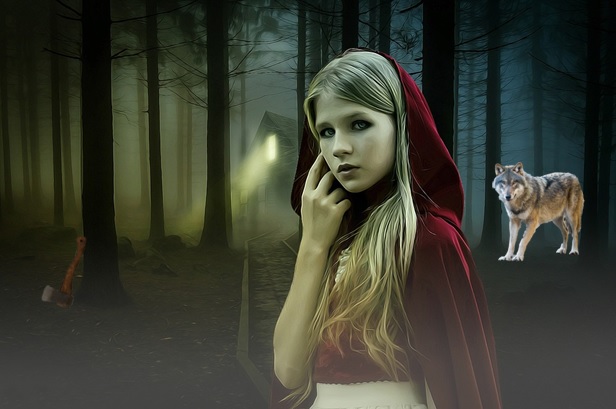
Fairy tales are generally regarded as children’s stories. However, they didn’t start out that way. In fact, the early folk tales, which were collected, compiled and subsequently edited by the Brothers Grimm, were initially considered inappropriate for children due to the degree of violence and the sexual innuendoes they contained.
It’s true that certain elements of the original stories were considerably altered by the Brothers Grimm to make them more suitable for their intended audience – and, no doubt, also more appealing. Yet, I can’t help but wonder how a collection of stories, which were probably once considered moderately disturbing, managed to be transformed into these magical, timeless tales.
Granted, there are still some subtle, little references in these stories that are indicative of their dark heritage. However, most children take things at face value and they don’t ‘read between the lines’ , so to speak. Of course, there are exceptions to every rule…
Take Little Red Riding Hood, for example. I can’t say that this story was ever a favourite of mine. Truthfully, I found it a bit creepy and weird as a child – mostly, because I could never quite understand how Little Red Riding Hood failed to notice that her grandmother had suddenly turned into a wolf.
Seriously? What on earth! As if something like that was not totally obvious. Unless, of course, her grandmother was a big, burly woman sprouting a considerable amount of facial hair with a long, sizeable schnoz and a set of very bad, yellow fangs – although that hardly sounds anything like a grandmother to me. In short, the only other alternative is that Little Red Riding Hood had either never met her grandmother before (in which case she really should’ve run away screaming when she did), or that she suffered from very poor eyesight and was in dire need of a pair of glasses. Yes, this certainly leads to a lot of speculation and some fairly unsatisfactory answers, although that’s not the worst of it.
No, the part of the story that truly annoyed me as a kid was when Little Red Riding Hood was standing before her so-called grandmother (i.e. the wolf) saying, “My, what big eyes you have, grandma.”
If ever there was a ‘no duh’ moment then that was it, and I invariably wanted to scream at Little Red Riding Hood for being so dimwitted. If it doesn’t look like grandma and it doesn’t smell like grandma, then it ain’t grandma, sweetie! How long is it going to take you to figure that one out, and why on earth are you still standing there asking stupid questions? Incidentally, Little Red Riding Hood is often portrayed as a brunette, and sometimes as a redhead, but it truly does make far more sense when she’s blonde.
As a whole, I wasn’t very impressed with the story. I guess a wolf running around in a nightie and frilly mobcap just didn’t do it for me. Not to mention that Little Red Riding Hood miraculously reappears after being eaten (and apparently swallowed whole despite the unlikely feasibility of that) thanks to a huntsman who decides to do an impromptu Caesarean on the wolf. And, amazingly, the wolf doesn’t feel a thing, because he sleeps right through the entire operation. Or, at least that’s how the story goes in the Brothers Grimm version. Like I said – weird!
Of course, I should probably give some credit where it’s due. The story may be a bizarre hodgepodge of crazy characters, but at least the storytellers got the wolf’s intentions right – and by that I mean that the wolf wanted to eat Little Red Riding Hood. After all, eating her would follow the natural order of things and is an adequate reason for his rather unorthodox stint at cross-dressing.
Not to mention that if the moral of the story is to warn children not to talk to strangers – or, indeed, creepy relatives – then I suppose it’s rather fitting after all. As Little Red Riding Hood proved, it’s very easy to be deceived by outward appearances, because you just never know what’s going on inside someone else’s head.
Perhaps, that’s the genius behind the success of the Brothers Grimm. Their tales are the perfect cocktail of goodness, innocence, menace and morality with just the right sprinkling of fairy dust.


 Audrey Whyte
Leave a reply to Jan B Cancel reply